
Root canal treatment is designed to eliminate infection and inflammation from inside a tooth while helping preserve the natural structure. In many cases, the treated tooth heals successfully and continues functioning for years. Occasionally, however, inflammation or infection can remain near the tip of the root even after previous treatment. When conventional retreatment is not appropriate or does not resolve the problem, working with an apicoectomy specialist Mission Viejo may provide another opportunity to save the tooth rather than remove it.
An apicoectomy, also known as root end surgery, is a specialized endodontic procedure focused on the very tip of a tooth root. It is generally considered when persistent inflammation or infection remains around the root end and the problem cannot be adequately addressed through the conventional root canal system.
Delta Root Canal explains that root end surgery may be recommended when retreatment is not indicated or when a lesion at the root end does not heal as expected. In some cases, surgery may also be needed when tissue must be removed for biopsy and further evaluation.
The procedure begins with careful diagnosis. A previously treated tooth may develop pain when chewing, tenderness, swelling, or changes visible on dental imaging. However, symptoms alone do not determine whether surgery is necessary. The endodontist must evaluate the tooth, previous root canal treatment, surrounding bone, and root anatomy before deciding whether apical surgery is the most appropriate next step.
Modern imaging can make this evaluation more precise. Cone-beam computed tomography, often called CBCT, provides a three-dimensional view of the tooth and surrounding structures. This can help identify persistent lesions, unusual anatomy, fractures, untreated areas, or other conditions that might influence the treatment plan.
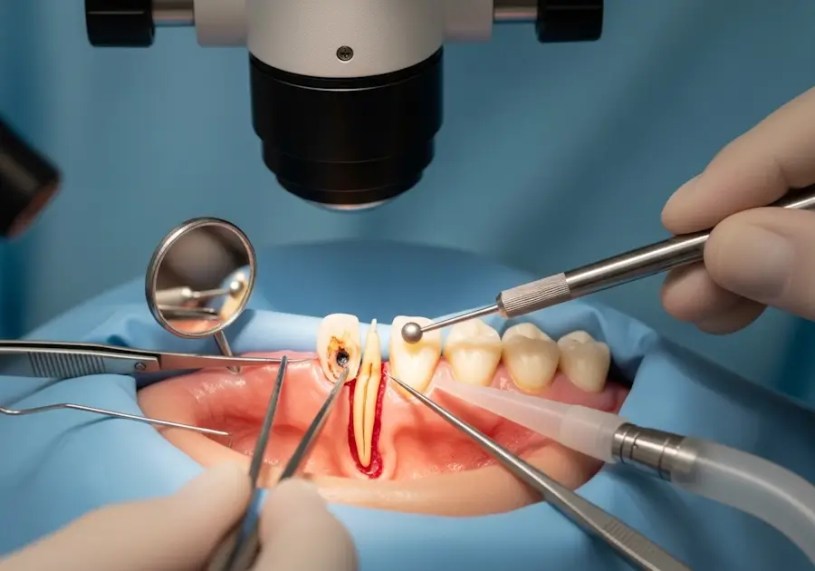
During an apicoectomy, the endodontist accesses the root tip through the surrounding gum tissue rather than reopening the tooth from the biting surface. Delta Root Canal states that approximately 3 to 5 millimeters of the root end may be removed during the procedure.
Removing the affected root tip allows the specialist to address the portion of the tooth associated with persistent inflammation or infection. The end of the root is then prepared and sealed with a bioceramic, biocompatible filling material. This material helps create a seal at the root end and supports the goal of preventing bacteria from re-entering the surrounding tissues.
In some cases, bone grafting may also be necessary. When infection or inflammation has affected the bone around the root, grafting material can sometimes be used to support healing and regeneration in the area.
One of the main reasons root end surgery is considered is tooth preservation. Extracting a tooth may eventually require replacement with an implant, bridge, or removable restoration. If the natural tooth can be treated successfully and remains structurally sound, endodontic surgery may offer a more conservative alternative.
Apicoectomy treatment is typically reserved for specific situations rather than being used as the first treatment for an infected tooth. Root canal therapy is generally the initial approach when the dental pulp is inflamed or infected. If a previously treated tooth develops problems, conventional retreatment may be considered next when appropriate.
Surgery becomes particularly valuable when accessing the problem through the crown of the tooth would be difficult or ineffective. Existing restorations, complex anatomy, or persistent disease at the root tip can sometimes make a surgical approach more practical.
Specialized equipment can improve precision during these procedures. Endodontic microscopes provide magnification and illumination that allow the specialist to see very small structures around the root end. Combined with advanced imaging, this can support accurate removal of affected tissue while preserving healthy surrounding structures.
Patient comfort is also an important part of treatment. Modern endodontic procedures are performed with appropriate anesthesia, and patients receive instructions for managing the surgical area afterward. Mild swelling or tenderness can occur during healing, but following post-treatment recommendations can support a smoother recovery.
Patients should also understand that follow-up care remains important. Healing around the root end occurs gradually, and imaging may be used over time to evaluate whether the surrounding bone and tissues are recovering appropriately.
A final restoration must also continue protecting the tooth. Teeth that have received root canal treatment commonly require crowns or other restorations to protect them from fracture and maintain normal function.
For patients experiencing persistent symptoms after previous root canal therapy, an apicoectomy specialist Mission Viejo can evaluate whether root end surgery offers a reasonable path toward preserving the tooth. Delta Root Canal provides root end surgery alongside retreatment, CBCT imaging, root resorption repair, trauma care, and other specialized endodontic procedures.
Persistent infection does not always mean extraction is the only option. With detailed diagnosis, modern imaging, surgical precision, and appropriate follow-up care, an apicoectomy can sometimes give a previously treated tooth another opportunity to remain healthy and functional.

