
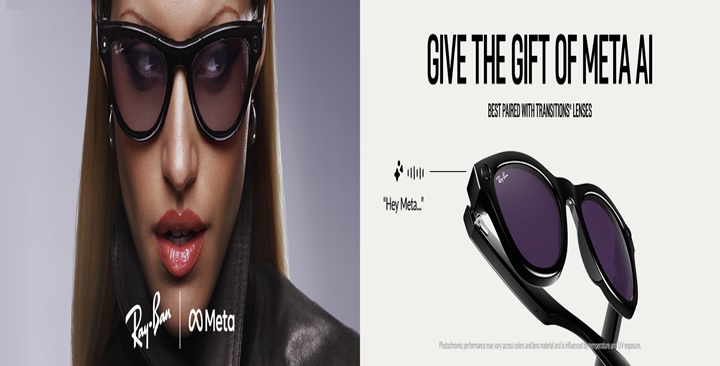
Eyewear has always been about vision first, style second. From the earliest prescription lenses to designer frames, glasses have balanced practicality with aesthetics. But in recent years, eyewear has begun to evolve in ways that stretch far beyond clarity of sight. Augmented reality (AR) glasses are at the centre of this shift, and few collaborations have generated as much interest as the partnership between Ray-Ban and Meta. These glasses are not just accessories; they represent a new way of interacting with the world.
What are Ray Ban Meta glasses?
Ray Ban Meta glasses are the result of a partnership between the iconic eyewear brand and Meta, the company behind Facebook, Instagram, and WhatsApp. On the surface, they look like classic Ray-Ban styles — the famous Wayfarer and Headliner silhouettes, for example. But hidden inside the frames are discreet cameras, microphones, and speakers, turning everyday glasses into connected, wearable technology.
This design choice is crucial. Unlike bulky VR headsets or early AR prototypes, Ray Ban Meta glasses prioritise wearability. They’re comfortable, stylish, and don’t scream “tech gadget” at first glance. It means people can wear them daily, blending technology into their routines without drawing unwanted attention.
Everyday applications
So, what can they do? For many, the most immediate benefit is the ability to capture photos and videos directly from your perspective. Instead of pulling out a phone, you simply tap the frame or use a voice command, and the glasses record what you see. This creates more authentic content — perfect for sharing moments on social media or simply keeping memories.
The integration with Meta platforms means you can livestream directly to Facebook or Instagram, a feature that appeals to content creators and influencers. But it’s not only about broadcasting; there’s real potential in practical, everyday use. Imagine walking through a busy street, taking a hands-free call, or listening to directions whispered into your ear without ever glancing at your phone. That’s the promise of Ray Ban Meta glasses — subtle, helpful integration of digital tools into the real world.
The social dimension
One of the biggest criticisms of smartphones is that they often pull people out of the moment. Heads bent over screens, conversations interrupted by notifications — it’s a familiar scene. Glasses like these attempt to reverse that trend. Because you don’t need to constantly hold a device, you can stay more engaged with your surroundings.
Of course, there are concerns about privacy. Recording from a pair of glasses can feel intrusive if others aren’t aware. Meta has attempted to address this with small indicator lights that show when the camera is in use. Whether that’s enough to reassure the public is still up for debate. Balancing innovation with responsibility will be a defining challenge for AR eyewear.
Fashion meets function
What makes Ray Ban Meta particularly interesting is how it brings together two worlds: heritage fashion and cutting-edge technology. Ray-Ban has long been a symbol of timeless style, worn by everyone from Hollywood stars to political leaders. By embedding technology within these iconic frames, Meta ensures the glasses appeal to people who care about aesthetics as much as functionality.
This marriage of design and technology might be what finally makes AR glasses mainstream. Previous attempts have often looked too experimental or awkward, putting off everyday wearers. But when you can buy a pair of glasses that look identical to your favourite shades, the barrier to entry becomes much lower.
Looking ahead
The current generation of Ray Ban Meta glasses is still relatively limited in function compared to the ambitious visions of full augmented reality. You won’t see 3D holograms hovering in front of you or detailed overlays guiding your every move just yet. Instead, what’s offered is a practical, accessible step forward — a device that fits into your lifestyle today while hinting at what’s possible tomorrow.
Future iterations may build on this foundation with richer AR experiences: translating signs in real time, offering health-tracking insights, or displaying messages directly in your line of sight. As technology advances and the hardware becomes even more compact, the glasses could evolve into an indispensable personal assistant.
The bigger picture
Ray Ban Meta glasses symbolise a broader shift in how we think about technology. For years, the smartphone has been the hub of our digital lives. But wearables are steadily decentralising that role, spreading functionality across watches, earbuds, and now glasses. Each device handles a different aspect of our interaction with technology, creating a more seamless ecosystem.
What’s striking is how quickly these changes move from novelty to normality. Ten years ago, talking to your wristwatch or using wireless earbuds with built-in assistants seemed futuristic. Today, it’s everyday behaviour. It’s easy to imagine a similar trajectory for smart glasses once the technology matures and social norms adjust.
Ray Ban Meta glasses may not yet deliver the full science-fiction vision of augmented reality, but they’re a meaningful step in that direction. By focusing on subtlety, style, and practical features, they’ve opened the door to a future where smart eyewear could become as common as smartphones.
The blend of Ray-Ban’s iconic frames with Meta’s connectivity offers a glimpse of what’s ahead: technology that doesn’t dominate our attention, but quietly supports it. In doing so, these glasses remind us that innovation doesn’t always mean abandoning the familiar — sometimes, it means enhancing it in ways we hadn’t expected.
 Everydayz Health Blog